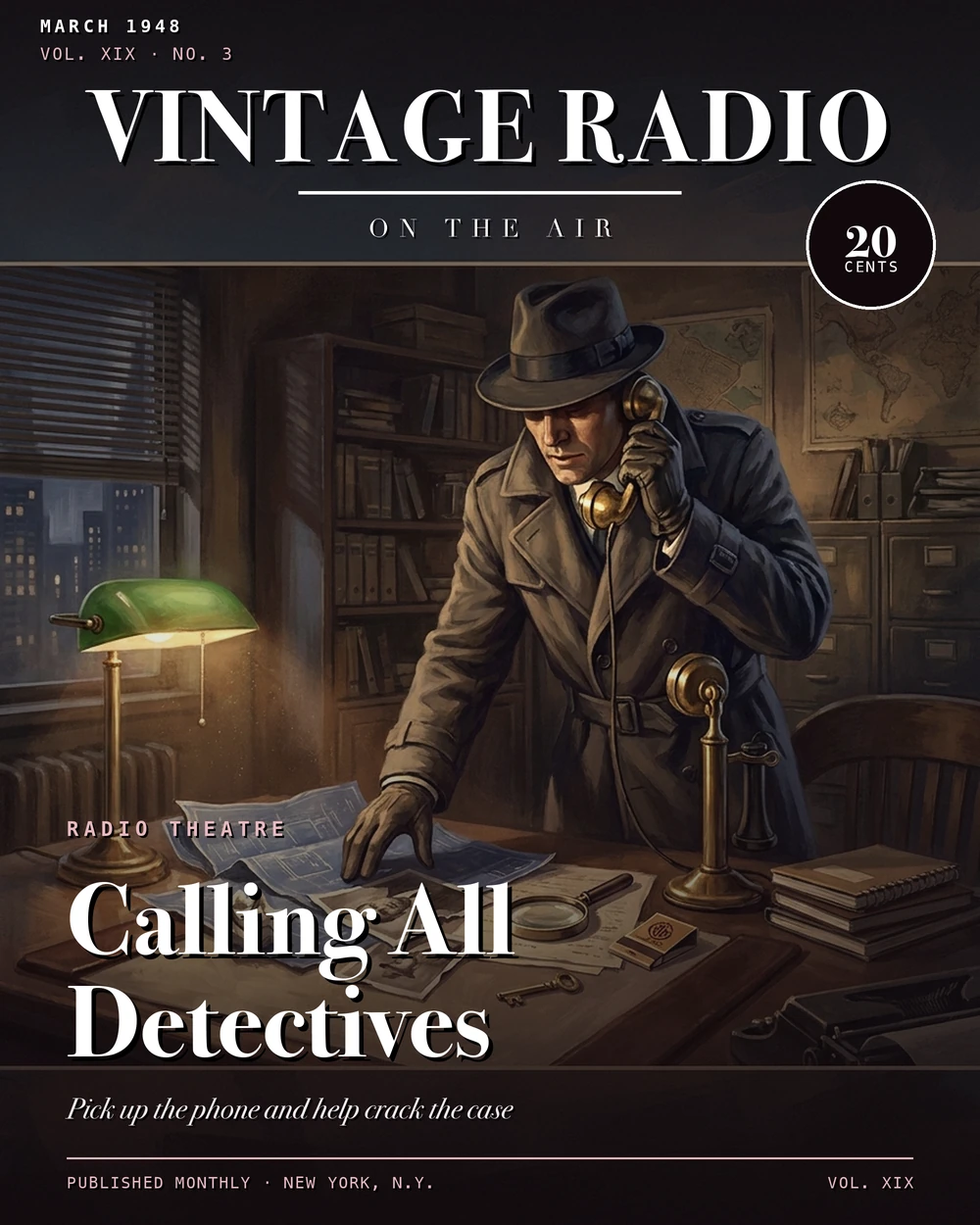
Calling All Detectives
A Gimmick That Actually Worked
Most crime-detective shows of the 1940s asked listeners to sit back and follow along. Calling All Detectives asked them to pick up the phone. When the Mutual network edition launched on April 7, 1945, it billed itself as the first program of its kind — a nationwide audience-participation mystery, with no direct predecessor in American radio crime programming. Variety reviewed it and called the mystery-quiz combination "a sweet gimmick," which was about right. The mechanics were clever, and they held together.
The format worked like this: host Vincent Pelletier played a character called Robin, who narrated a whodunit and fed clues to the audience as the plot unfolded. Near the climax, the network handed five minutes of airtime to local Mutual affiliates, and during that window, station personnel called a listener who had been pre-selected from mailed-in postcards — and had already been contacted earlier in the broadcast to confirm they were home. If the listener could name the criminal, they won a prize. War bonds were among the awards. If the answer was wrong, the prize value rolled over and grew for the following week, so stakes escalated differently at every affiliate across the country. After the local segment ended, the network reclaimed the broadcast and finished the story. It was interactive radio engineering, built around the telephone infrastructure of the mid-forties.
Variety specifically credited writer Kenneth Houston, director Alan M. Fishburn, Pelletier's narration, and organist Dick Platt's work for making the formula land. Announcer George Bower rounded out the production team. The 1945 Mutual run aired Saturdays at 9:30 for thirty minutes, sponsored by the Sealy Mattress Company, whose advertising copy assured listeners that "sleeping on a Sealy is like sleeping on a cloud." The network run closed on August 25, 1945.
The Syndicated Version
Because the live Mutual broadcasts were transcribed as they aired, a usable archive of recordings existed once the network run ended. Starting around 1947, a separate syndicated edition began circulating — produced not by the original Mutual team but by Jerry Joss Features, with Larry Kurtz directing. This version stripped the show down to fifteen minutes, removed the commercials and telephone segments from the original transcriptions, and built something structurally different: a compact crime melodrama of eight or nine minutes, followed by a brief audience-participation phone segment.
The entire cast of the syndicated version was one person. Paul Barnes — billed as "man of a thousand voices," a reputation he had built as the voice of the second Captain Midnight on network radio — played detective Jerry Browning and every other character in each episode. His only collaborator was a sound effects technician. Barnes worked with freelance scripts, gave voice to the full cast himself, and produced something that one researcher described as having "fully formed characters and plot," making each eight-minute story feel longer than it had any right to.
The phone-call format in the syndicated version evolved. Barnes initially dialed numbers at random from a phone book, which proved unreliable. The format later shifted to calling only listeners who had sent in cards — the same solution the 1945 network edition had used. Correct callers qualified for a jackpot question. Variety reviewed this version too, and was less impressed: the quarter-hour was too tight for combining "a capsule whodunit and a telephone quiz game," and Barnes seemed "on a treadmill trying to fit the script into the available time."
Paul Barnes
Barnes brought a wide range of radio experience to the show. Before Calling All Detectives, he had appeared in The Guiding Light, worked as a newscaster during World War II, and built his freelance career across Chicago and New York. His union involvement was substantial: he served as president of both the American Federation of Television and Radio Artists and the Screen Actors Guild, and was a member of Actors Equity. He died on May 16, 1983, at age 64, at Sherman Hospital in Elgin, Illinois.
What Survives
The syndicated run produced a very large number of episodes — sequence numbers in the surviving recordings reach at least into the high 300s, with episode 342 dated December 28, 1948. The earliest recordings run longer than the standard format: an April 16, 1947 episode titled "Elusive Diamond Thief" runs about seventeen minutes, while by mid-1948 episodes had settled into the eight-minute stripped form. Sample titles from those years give a sense of the range — "Mr. Frobish Pays to Have Himself Killed," "The Ship Julia Lane Carries Gold," "Jerry Witnesses a Murder on TV," "Scrub Woman Receives Orchids From an Unknown Admirer." At least two surviving syndicated episodes retain the live caller segment that was normally edited out, making them a slightly different artifact from the rest. The show also carried the alternate catalog title Casebook of Jerry Browning, reflecting the lead character's name. Frank Lovejoy, who later became a well-known radio actor on programs like Gang Busters and Night Beat, appeared in supporting roles on the 1945 Mutual network edition alongside Owen Jordan.